Overview of Peptide Reconstitution
Peptide reconstitution is a fundamental laboratory procedure that transforms a lyophilized (freeze-dried) peptide powder into a liquid solution suitable for in-vitro or animal model research. Because peptides are complex chains of amino acids, their molecular structure is highly sensitive to environmental factors, including temperature, pH, and agitation. Proper reconstitution is critical to maintaining the structural integrity and biological activity of the compound. All information provided in this guide is strictly for laboratory reference. Catalyst Sciences products are for research use only (RUO) and are not intended for human consumption or therapeutic use.
Understanding Lyophilization
Before discussing reconstitution, it is essential to understand why research peptides are lyophilized. Lyophilization is a dehydration process used to preserve perishable materials. By freezing the peptide and then reducing the surrounding pressure to allow the frozen water to sublimate directly from the solid phase to the gas phase, the peptide’s molecular structure is stabilized. This results in a “cake” or powder that can remain stable at room temperature during shipping or at 2-8°C for extended storage (Wang, 2000). However, to be utilized in biological assays or murine models, the peptide must be returned to an aqueous state.
Selecting the Appropriate Diluent
The choice of diluent is the first critical decision in the reconstitution process. The diluent must be compatible with the specific peptide’s solubility profile and the intended duration of the experiment.
1. Bacteriostatic Water (BAC)
Bacteriostatic Water is the standard diluent for most peptide research. It is sterile water containing 0.9% benzyl alcohol. The benzyl alcohol acts as a bacteriostatic preservative, inhibiting the growth of most bacteria. This is crucial for multi-dose vials or experiments that span several weeks. Solutions reconstituted with BAC water typically remain stable for 2-4 weeks when stored at 2-8°C, provided the peptide itself is stable in solution.
2. Sterile Water for Injection (SWFI)
Sterile Water for Injection is pure, sterile water without any preservatives. It is used when the benzyl alcohol in BAC water might interfere with the specific assay or if the entire reconstituted volume will be used immediately. Because it lacks a preservative, solutions made with SWFI are highly susceptible to bacterial contamination and should be utilized within 24-48 hours (Manning et al., 1989).
3. Acetic Acid (0.1M – 1M)
Certain peptides are highly basic and hydrophobic, making them insoluble in pure water. For these compounds (e.g., certain fragments of IGF-1), researchers may use a small amount of dilute acetic acid (10-20% of the total desired volume) to dissolve the peptide first, before adding BAC or SWFI to reach the final volume.
4. Ammonium Hydroxide
Conversely, highly acidic peptides may require a basic solvent for initial dissolution. A dilute solution of ammonium hydroxide is typically used in these rare cases.
The Reconstitution Procedure
Precision and care are paramount during the physical act of reconstitution. The goal is to introduce the diluent without causing mechanical stress to the peptide bonds.
- Preparation: Ensure the workspace is clean. Swab the rubber stoppers of both the peptide vial and the diluent vial with 70% isopropyl alcohol and allow them to air dry.
- Pressure Equalization: Lyophilized vials often contain a vacuum. Injecting air into the diluent vial equalizes pressure, making it easier to draw the fluid.
- Drawing the Diluent: Using a sterile syringe, draw the predetermined volume of diluent.
- Introduction of Diluent: Insert the needle into the center of the peptide vial’s stopper. Crucially, do not inject the diluent directly onto the lyophilized cake. Instead, angle the needle so the diluent flows slowly down the inner wall of the glass vial. This prevents mechanical shearing of the delicate peptide chains.
- Dissolution: Once the diluent is added, gently swirl the vial using a circular motion. Do not shake the vial. Shaking can cause foaming and mechanical degradation of the peptide. Allow the vial to sit at room temperature for several minutes until the solution is completely clear.
- Inspection: The final solution should be clear and free of particulate matter. If the solution remains cloudy after several minutes of gentle swirling, the peptide may not be fully soluble in the chosen diluent, or it may have degraded.
Laboratory Reconstitution Math
Accurate dosing in laboratory models relies on precise concentration calculations. The concentration is determined by the mass of the peptide divided by the volume of the diluent.
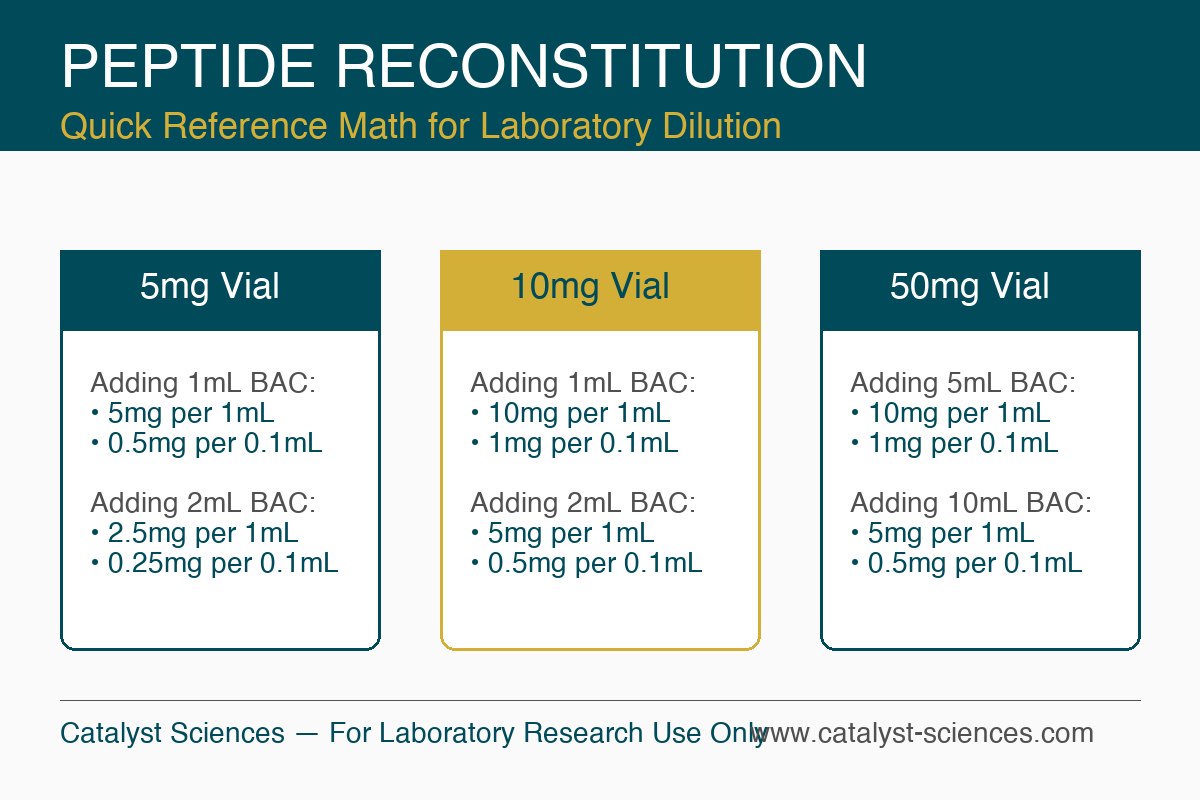
Laboratory Reference Guide for Peptide Reconstitution
Reference Examples
Example 1: A 10mg Vial of Tirzepatide
- If you add 1mL of BAC water: The concentration is 10mg / 1mL. Therefore, 0.1mL (10 units on a standard U-100 syringe) contains 1mg of peptide.
- If you add 2mL of BAC water: The concentration is 10mg / 2mL, or 5mg / 1mL. Therefore, 0.1mL contains 0.5mg of peptide.
Example 2: A 5mg Vial of Retatrutide
- If you add 1mL of BAC water: The concentration is 5mg / 1mL. Therefore, 0.1mL contains 0.5mg of peptide.
- If you add 2mL of BAC water: The concentration is 5mg / 2mL, or 2.5mg / 1mL. Therefore, 0.1mL contains 0.25mg of peptide.
Storage of Reconstituted Peptides
Once reconstituted, the stability timeline of the peptide begins to rapidly decrease. Aqueous peptide solutions are susceptible to hydrolysis, oxidation, and deamidation (Cleland et al., 1993).
- Refrigeration: All reconstituted peptide solutions must be stored at 2-8°C (standard refrigeration). At this temperature, most peptides remain stable for 14-28 days when reconstituted with BAC water.
- Light Exposure: Peptides are photosensitive. Store vials in a dark environment or wrap them in foil to prevent UV degradation.
- Freeze-Thaw Cycles: Avoid freezing and thawing reconstituted peptides. The physical expansion and contraction of the water molecules can cause significant mechanical stress, leading to aggregation and loss of efficacy. If an experiment requires long-term storage of an aqueous solution, aliquot the solution into smaller volumes and freeze them at -20°C. Thaw each aliquot only once immediately before use.
Common Reconstitution Issues
Cloudy Solutions
If a solution remains cloudy after adding the diluent, it indicates incomplete solubility. This can occur if the pH of the diluent is incompatible with the peptide’s isoelectric point. For example, highly hydrophobic peptides may require a drop of acetic acid to fully dissolve. Do not use a cloudy solution in biological assays, as the peptide is not uniformly distributed, leading to inaccurate dosing and potentially skewed experimental data.
Gel Formation
Some highly concentrated peptides (e.g., high-dose BPC-157 or specific proprietary blends) can form a gel if the diluent volume is too low. In these cases, adding more diluent and gently swirling is usually sufficient to break the gel and achieve a clear solution.
Conclusion
Mastering peptide reconstitution is an essential skill for any laboratory researcher. By selecting the appropriate diluent, utilizing careful physical techniques to avoid mechanical shearing, and calculating concentrations accurately, researchers can ensure the integrity and reproducibility of their data. Always adhere to best practices for storage to maximize the functional lifespan of the compound.
References:
- Wang, W. (2000). Lyophilization and development of solid protein pharmaceuticals. International Journal of Pharmaceutics, 203(1-2), 1-60.
- Manning, M. C., Patel, K., & Borchardt, R. T. (1989). Stability of protein pharmaceuticals. Pharmaceutical Research, 6(11), 903-918.
- Cleland, J. L., Powell, M. F., & Shire, S. J. (1993). The development of stable protein formulations: a close look at protein aggregation, deamidation, and oxidation. Critical Reviews in Therapeutic Drug Carrier Systems, 10(4), 307-377.
Disclaimer: This article is for informational laboratory reference only. Catalyst Sciences products are sold strictly for laboratory research use only (RUO). Not for human or veterinary use. Not a drug, food, or cosmetic. Not for diagnostic or therapeutic use.