The Role of Diluents in Peptide Research
The selection of an appropriate diluent is a critical variable in any in-vitro or murine peptide study. Lyophilized peptides must be dissolved in a solvent that not only maintains their structural integrity but also aligns with the experimental timeline and physiological requirements of the assay. Incompatible diluents can cause rapid degradation, precipitation, or introduction of variables that confound research data. This guide serves as a laboratory reference for diluent selection. Catalyst Sciences products are strictly for research use only (RUO) and not for human consumption.
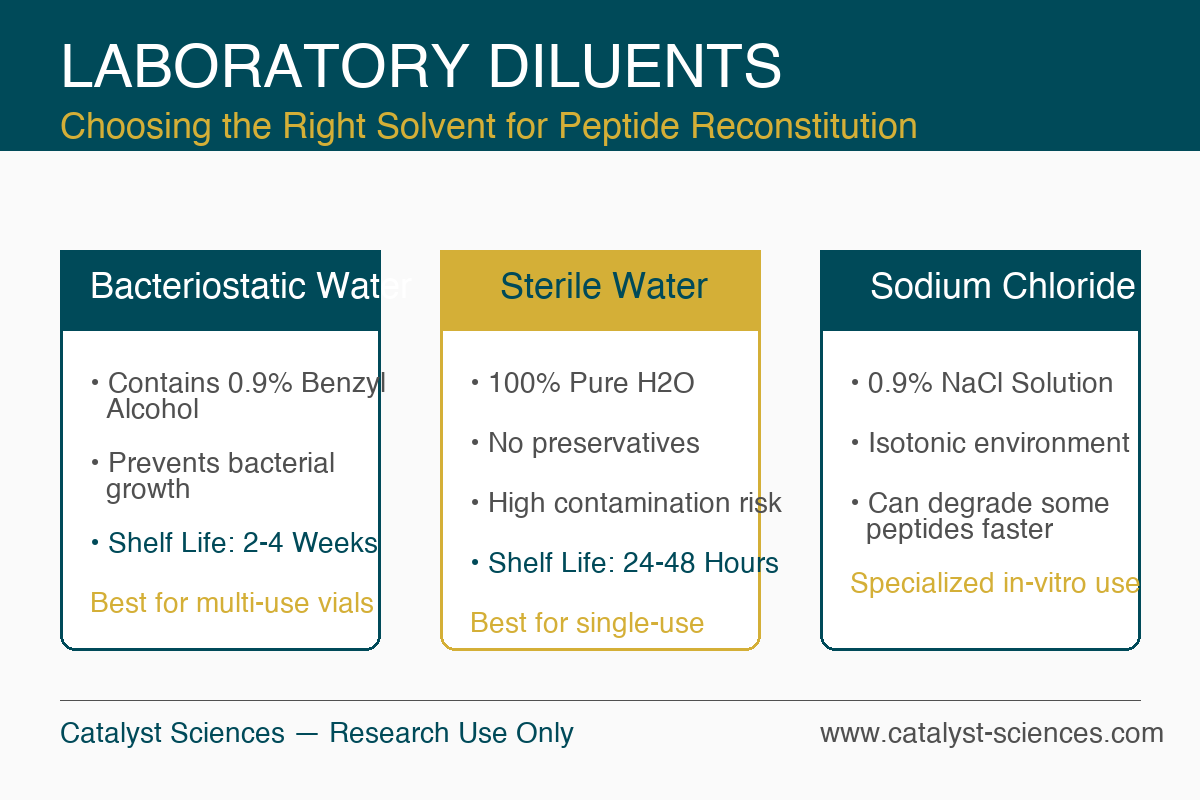
Choosing the Right Solvent for Peptide Reconstitution
Bacteriostatic Water (BAC)
Bacteriostatic Water is the gold standard for most peptide reconstitution in laboratory settings. It consists of sterile water containing 0.9% benzyl alcohol. The primary function of the benzyl alcohol is to act as a bacteriostatic preservative, preventing the growth of most bacteria within the vial.
Advantages
- Extended Shelf Life: Peptides reconstituted with BAC water typically remain stable for 2 to 4 weeks when stored at 2-8°C.
- Multi-Use Feasibility: Because it inhibits bacterial growth, it is ideal for multi-use vials where aliquots are drawn over several days or weeks.
Limitations
The benzyl alcohol can occasionally interact with highly sensitive biological assays, particularly those involving live cell cultures where the alcohol might induce cytotoxicity. Furthermore, some highly hydrophobic peptides may precipitate in the presence of benzyl alcohol.
Sterile Water for Injection (SWFI)
Sterile Water for Injection is exactly what it sounds like: 100% pure, sterile H2O with no added preservatives or buffers. It provides a completely neutral environment for peptide dissolution.
Advantages
- No Interference: The absence of benzyl alcohol means SWFI will not interfere with sensitive cell cultures or specific enzymatic assays.
- Universal Solvent: It acts as a pure baseline solvent for almost all water-soluble peptides.
Limitations
Because SWFI lacks a preservative, any introduction of bacteria (even from a sterile needle puncturing the septum) can lead to rapid proliferation. Therefore, peptides reconstituted in SWFI must be utilized immediately or within 24 to 48 hours maximum, even when refrigerated.
Sodium Chloride (0.9% NaCl)
Sodium Chloride (normal saline) is a solution of 0.90% w/v of NaCl in water. It is an isotonic solution, meaning it has the same osmotic pressure as mammalian cellular fluids.
Advantages
- Isotonicity: NaCl is often required when the peptide solution will be introduced into an environment where osmotic balance is critical, such as certain ex-vivo tissue studies.
Limitations
Sodium chloride is generally not recommended for the long-term storage of reconstituted peptides. The presence of sodium and chloride ions can accelerate the degradation of certain peptide bonds, significantly reducing the functional lifespan of the compound compared to BAC water.
Conclusion
For the vast majority of standard peptide research requiring multi-aliquot sampling over several weeks, Bacteriostatic Water is the required diluent. Sterile Water is reserved for immediate, single-use assays, while Sodium Chloride is utilized only when isotonicity is a strict requirement of the experimental design.
Disclaimer: This article is for informational laboratory reference only. Catalyst Sciences products are sold strictly for laboratory research use only (RUO). Not for human or veterinary use. Not a drug, food, or cosmetic. Not for diagnostic or therapeutic use.