The Science of Peptide Stability
Research peptides are highly specialized chains of amino acids whose biological efficacy depends entirely on their structural integrity. Environmental factors such as temperature, light exposure, and physical agitation can cause these chains to denature, aggregate, or oxidize, rendering them useless for laboratory research. Understanding proper storage protocols is essential for yielding accurate and reproducible data. This guide serves as a laboratory reference for peptide storage. Catalyst Sciences products are strictly for research use only (RUO) and not for human consumption.
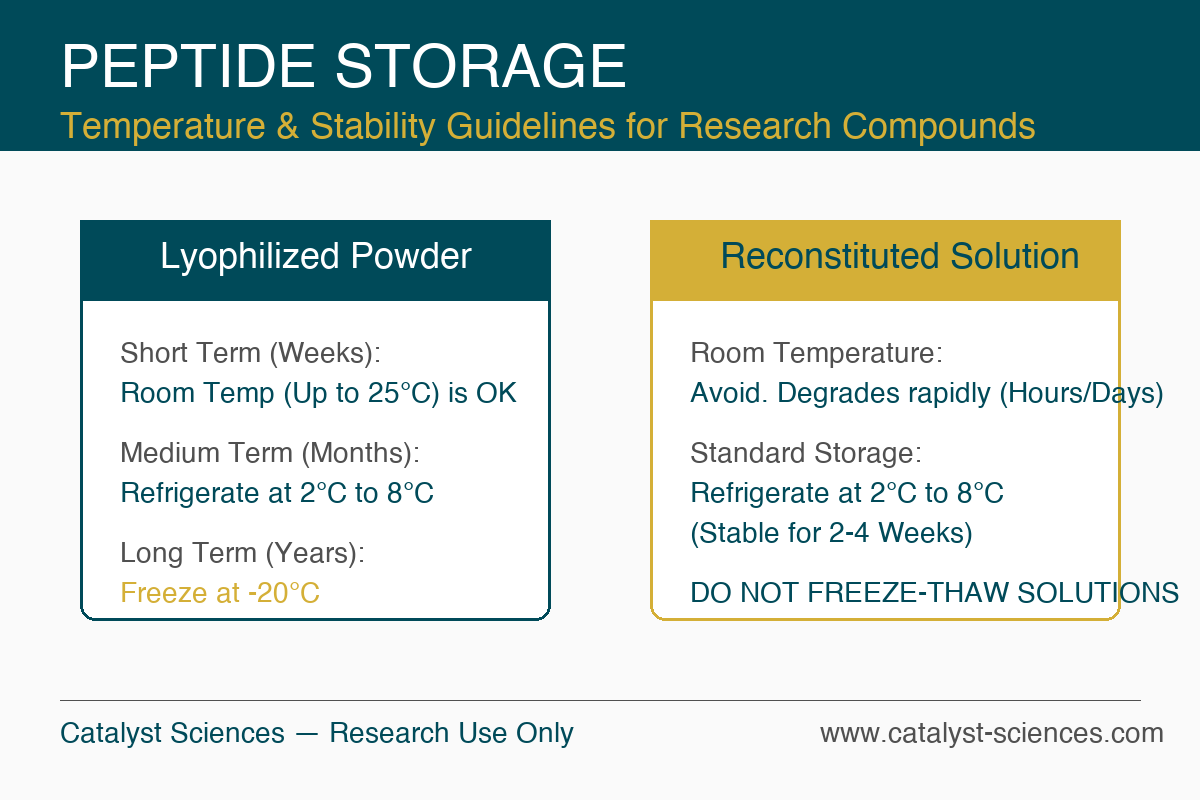
Temperature & Stability Guidelines for Research Compounds
Lyophilized Powder Storage
When you receive research peptides, they arrive in a lyophilized (freeze-dried) state. Lyophilization removes water from the compound under a vacuum, severely restricting molecular mobility and preventing the chemical reactions that lead to degradation.
Short-Term Storage (Days to Weeks)
In their lyophilized state, most peptides are remarkably stable. They can survive shipping and remain at room temperature (up to 25°C) for several weeks without significant degradation. However, they should be kept away from direct sunlight and extreme heat.
Medium-Term Storage (Months)
If the peptides will not be utilized within a few weeks, they should be stored in a standard laboratory refrigerator at 2°C to 8°C. At these temperatures, the lyophilized cake remains stable for many months.
Long-Term Storage (Years)
For deep storage spanning a year or more, lyophilized vials should be placed in a laboratory freezer at -20°C. It is critical to allow the vial to reach room temperature before breaking the seal or adding diluent to prevent ambient moisture from condensing inside the cold vial.
Reconstituted Solution Storage
The introduction of a diluent (such as Bacteriostatic Water) returns the peptide to an aqueous state. In this state, the peptide regains its molecular mobility and becomes highly susceptible to hydrolysis and oxidation.
Refrigeration is Mandatory
Once reconstituted, peptides must never be left at room temperature for extended periods. They must be stored at 2°C to 8°C immediately after use. When stored properly in a refrigerator, a peptide reconstituted with Bacteriostatic Water will typically remain stable for 14 to 28 days.
The Danger of Freeze-Thaw Cycles
A common mistake in laboratory research is freezing a reconstituted peptide solution to extend its life. Do not freeze and thaw reconstituted peptides. The process of water freezing causes ice crystals to expand, which physically shears and destroys the fragile peptide bonds. Furthermore, during thawing, localized concentration gradients occur that can cause irreversible aggregation of the peptide molecules.
If an experimental design strictly requires long-term storage of an aqueous solution, researchers must aliquot the solution into small, single-use vials before freezing them at -20°C. Each aliquot is then thawed exactly once immediately prior to the assay.
Conclusion
Proper storage is the foundation of reliable peptide research. Lyophilized powders offer significant flexibility and can be frozen for years, while reconstituted solutions demand strict refrigeration and must be protected from freeze-thaw degradation.
Disclaimer: This article is for informational laboratory reference only. Catalyst Sciences products are sold strictly for laboratory research use only (RUO). Not for human or veterinary use. Not a drug, food, or cosmetic. Not for diagnostic or therapeutic use.