The Evolution of Metabolic Research
The landscape of metabolic and endocrinological research has been revolutionized by the development of Glucagon-Like Peptide-1 (GLP-1) receptor agonists. Initially isolated from the venom of the Gila monster (exendin-4), these compounds have undergone decades of structural refinement. Today, researchers utilize advanced synthetic analogues to study the mechanisms of insulin secretion, gastric motility, and adipose tissue regulation in murine models. This guide provides a structural overview of modern GLP-1 analogues. Catalyst Sciences products are strictly for research use only (RUO) and not for human consumption.
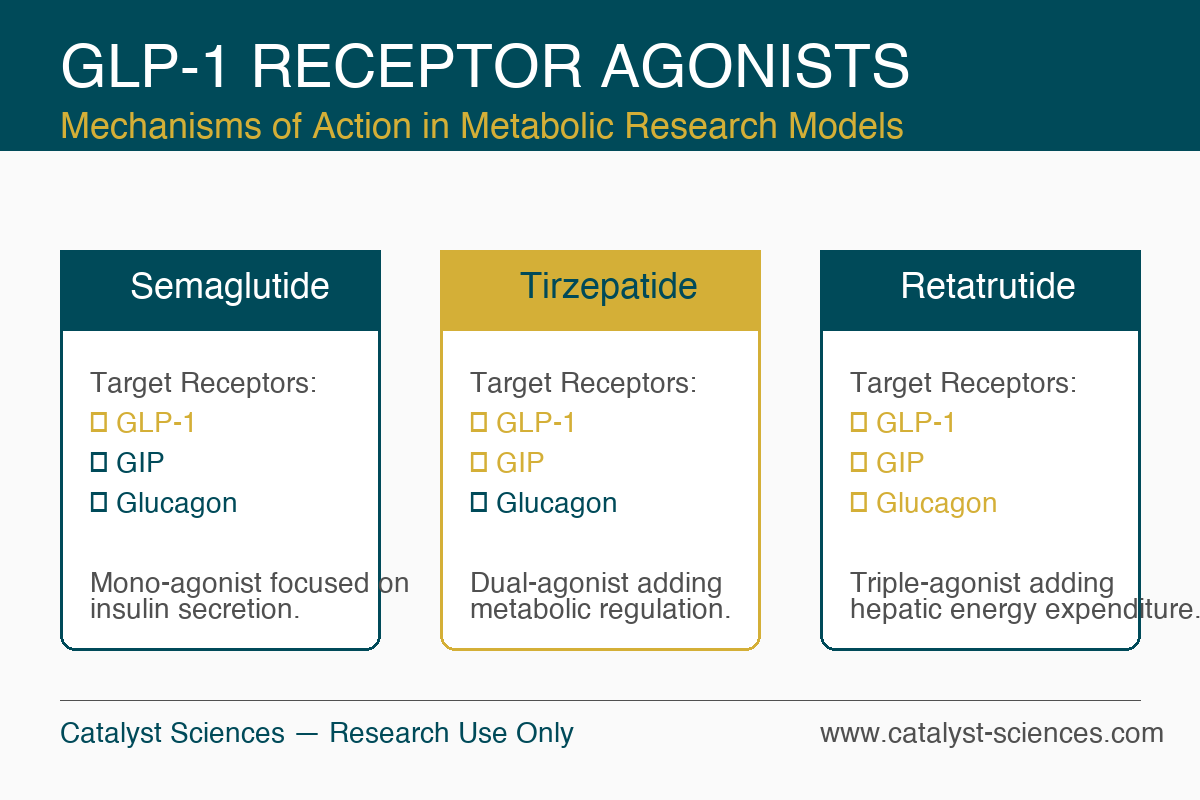
Mechanisms of Action in Metabolic Research Models
Semaglutide: The GLP-1 Mono-Agonist
Semaglutide represents the maturation of the first-generation GLP-1 analogues. It is a strict mono-agonist, meaning it selectively targets and binds only to the GLP-1 receptor. Structurally, it is heavily modified with an albumin-binding fatty acid chain, which protects the peptide from rapid degradation by the DPP-4 enzyme.
In laboratory models, Semaglutide is utilized to study glucose-dependent insulinotropic effects. By activating GLP-1 receptors in the pancreas, it stimulates insulin secretion only when ambient glucose levels are elevated. Furthermore, researchers observe profound reductions in gastric emptying rates and alterations in hypothalamic feeding centers in animal models, leading to significant caloric restriction paradigms without the need for manual diet suppression.
Tirzepatide: The Dual-Agonist
Tirzepatide represents the “second generation” of these metabolic compounds. It is a dual-agonist, engineered to bind to both the GLP-1 receptor and the Glucose-Dependent Insulinotropic Polypeptide (GIP) receptor simultaneously.
The addition of GIP agonism provides a synergistic effect in research models. While GLP-1 primarily handles insulin secretion and satiety, GIP receptors are heavily expressed in adipose tissue. In-vitro studies demonstrate that GIP activation enhances the insulin sensitivity of adipocytes and promotes lipid buffering. Researchers studying Tirzepatide frequently observe that the dual-action mechanism results in greater overall metabolic shifts in murine models compared to mono-agonists, highlighting the complex crosstalk between different incretin pathways.
Retatrutide: The Triple-Agonist
Retatrutide is the bleeding edge of metabolic peptide research. It is a tri-agonist that targets GLP-1, GIP, and the Glucagon receptor. The inclusion of glucagon agonism was initially counter-intuitive to researchers, as glucagon historically raises blood sugar.
However, when combined with GLP-1 and GIP, the glucagon agonism shifts its functional role. In animal models, the activation of the glucagon receptor drastically increases hepatic (liver) energy expenditure and basal metabolic rate. Therefore, while GLP-1 and GIP suppress caloric intake and manage insulin, the glucagon receptor actively forces the organism to burn stored lipids at an accelerated rate. Retatrutide is currently the premier compound for researching rapid, synergistic metabolic remodeling.
Conclusion
The progression from mono-agonists to tri-agonists illustrates the immense complexity of incretin biology. By studying these compounds in parallel, researchers can isolate specific receptor pathways to better understand systemic metabolic regulation.
Disclaimer: This article is for informational laboratory reference only. Catalyst Sciences products are sold strictly for laboratory research use only (RUO). Not for human or veterinary use. Not a drug, food, or cosmetic. Not for diagnostic or therapeutic use.