Research Peptide Terminology
Navigating the scientific literature surrounding peptide research requires a firm grasp of specific biochemical terminology. From synthesis protocols to receptor agonism, the language of endocrinology is highly specialized. This glossary serves as a foundational laboratory reference for common terms used throughout the Catalyst Sciences hub. Catalyst Sciences products are strictly for research use only (RUO) and not for human consumption.
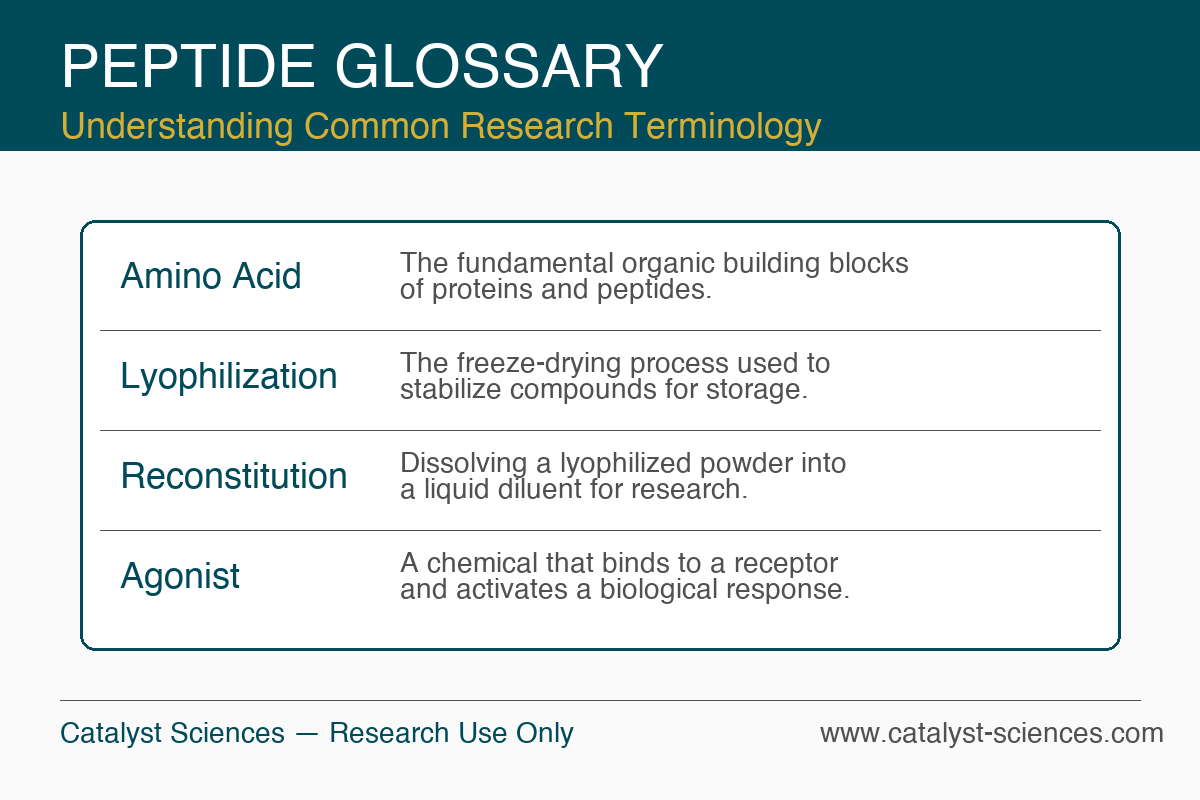
Understanding Common Research Terminology
Foundational Biochemistry
- Amino Acid: The fundamental organic building blocks that combine to form proteins and peptides. There are 20 standard amino acids encoded by the human genetic code.
- Peptide: A short chain of amino acids linked by peptide bonds. While the exact cutoff varies, molecules with fewer than 50 amino acids are generally considered peptides, while larger chains are classified as proteins.
- Polypeptide: A longer, continuous, unbranched peptide chain.
- Half-Life (t½): The amount of time required for the concentration of a substance in the body (or in a biological model) to reduce to exactly half its initial value.
Laboratory Procedures
- Lyophilization: A freeze-drying process that removes water from a biological sample under a vacuum, creating a highly stable powder that resists degradation.
- Reconstitution: The process of adding a liquid diluent to a lyophilized powder to return it to an aqueous solution for research applications.
- Bacteriostatic Water (BAC): Sterile water containing 0.9% benzyl alcohol, used as a diluent to prevent bacterial growth and extend the shelf-life of reconstituted solutions.
- Subcutaneous (SQ/SubQ): Situated or applied under the skin. In murine models, this refers to injections placed into the adipose tissue layer beneath the dermis.
Analytical Testing
- COA (Certificate of Analysis): A verified document from a third-party laboratory confirming that a manufactured compound meets its specified requirements.
- HPLC (High-Performance Liquid Chromatography): An analytical chemistry technique used to separate, identify, and quantify each component in a mixture, establishing the purity of a peptide.
- Mass Spectrometry (MS): An analytical tool that measures the mass-to-charge ratio of ions, used to verify the exact molecular identity of a synthesized compound.
Pharmacodynamics
- Agonist: A chemical that binds to a receptor and activates the receptor to produce a biological response.
- Antagonist: A chemical that binds to a receptor but blocks or dampens the biological response.
- Secretagogue: A substance that causes another substance to be secreted. For example, a Growth Hormone Secretagogue (GHS) signals the pituitary to secrete growth hormone.
- Incretin: A group of metabolic hormones that stimulate a decrease in blood glucose levels. GLP-1 and GIP are the primary incretins studied in metabolic research.
Disclaimer: This article is for informational laboratory reference only. Catalyst Sciences products are sold strictly for laboratory research use only (RUO). Not for human or veterinary use. Not a drug, food, or cosmetic. Not for diagnostic or therapeutic use.