Understanding Growth Hormone Secretagogues in Research
Growth Hormone Secretagogues (GHS) are a class of synthetic peptides designed to stimulate the endogenous secretion of growth hormone (GH) from the anterior pituitary gland. Unlike recombinant human growth hormone (rhGH), which introduces exogenous hormone directly into the system, GHS compounds prompt the subject’s own biology to produce and release GH. This preserves the natural pulsatile rhythm of secretion and avoids the rapid desensitization often associated with exogenous hormone administration. This guide provides a laboratory reference for GHS mechanisms. Catalyst Sciences products are strictly for research use only (RUO) and not for human consumption.
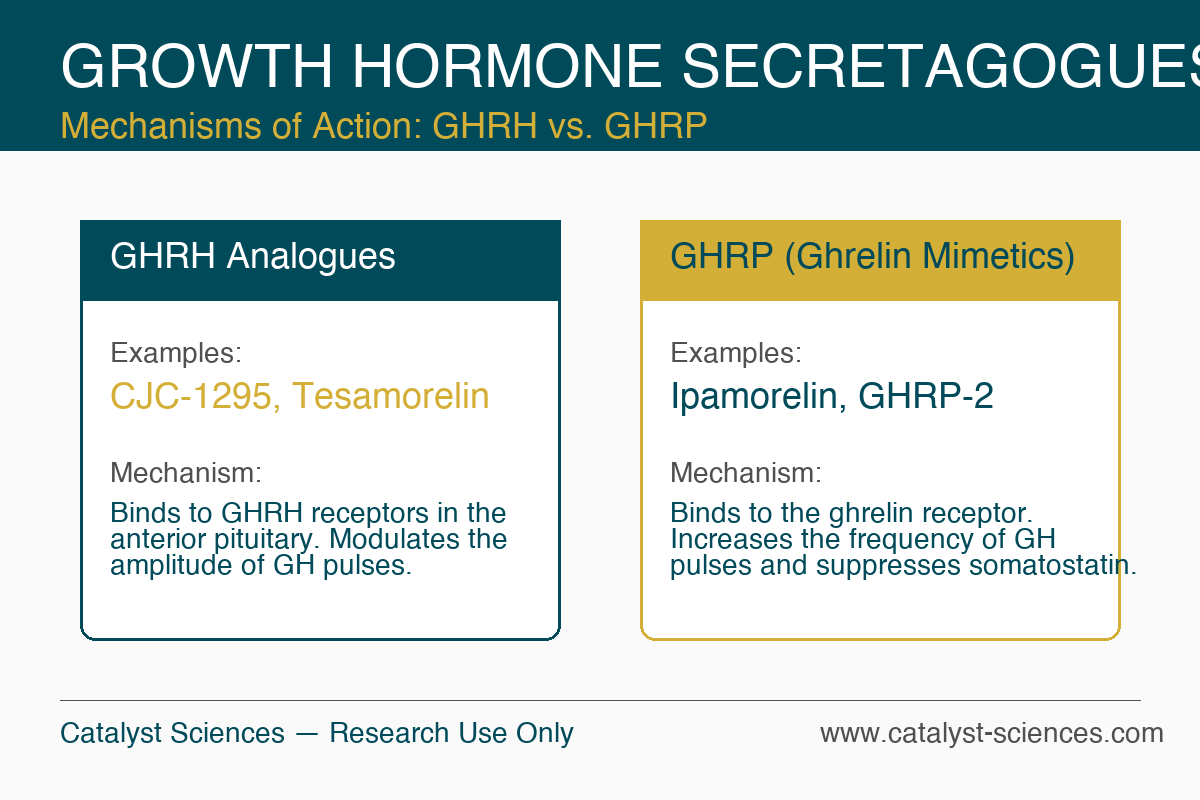
Mechanisms of Action: GHRH vs. GHRP
GHRH Analogues (Growth Hormone Releasing Hormone)
GHRH analogues are synthetically modified versions of the naturally occurring 44-amino-acid peptide produced in the hypothalamus. These compounds bind to the GHRH receptor in the pituitary. Their primary function in laboratory models is to increase the amplitude (the physical amount) of growth hormone released during a natural GH pulse.
CJC-1295
CJC-1295 is a 29-amino-acid GHRH analogue. The original molecule, GRF(1-29), had a very short half-life. Researchers modified it with Drug Affinity Complex (DAC) technology to bind to serum albumin, extending its half-life to several days. In research models, this creates a steady, continuous elevation of basal GH levels. Alternatively, CJC-1295 without DAC (often called Modified GRF 1-29) has a shorter half-life (roughly 30 minutes) and is utilized to create acute spikes in GH rather than continuous elevation.
Tesamorelin
Tesamorelin is a highly specialized GHRH analogue featuring a unique trans-3-hexenoic acid group attached to the N-terminus. This modification significantly increases its stability and resistance to DPP-4 enzymatic degradation. In metabolic research, Tesamorelin has demonstrated a profound ability to target and reduce visceral adipose tissue (VAT) accumulation compared to other GHRH analogues, making it a primary compound for studying lipodystrophy models.
GHRP Compounds (Growth Hormone Releasing Peptides)
Unlike GHRH analogues, GHRPs do not bind to the GHRH receptor. Instead, they act as mimetics for ghrelin, the “hunger hormone,” and bind to the Growth Hormone Secretagogue Receptor (GHSR-1a). Their primary mechanism is to increase the frequency of GH pulses while simultaneously suppressing somatostatin (the hormone that halts GH release).
Ipamorelin
Ipamorelin is considered a “third-generation” GHRP. It is highly valued in research due to its selectivity. Earlier GHRPs (like GHRP-6 and GHRP-2) often caused significant spikes in cortisol, prolactin, and profound gastric hunger. Ipamorelin, however, stimulates robust GH release without significantly elevating cortisol or prolactin, making it the cleanest GHRP for long-term physiological studies.
The Synergistic Effect
The hallmark of modern endocrine research is the co-administration of a GHRH and a GHRP (most commonly CJC-1295 Without DAC and Ipamorelin). Because they act on two entirely different receptors, their combination produces a synergistic effect rather than an additive one. The GHRP (Ipamorelin) initiates the pulse and suppresses the off-switch (somatostatin), while the GHRH (CJC-1295) dramatically amplifies the volume of GH released during that pulse. This combination yields the maximum physiological response in murine models while maintaining endogenous regulatory pathways.
Disclaimer: This article is for informational laboratory reference only. Catalyst Sciences products are sold strictly for laboratory research use only (RUO). Not for human or veterinary use. Not a drug, food, or cosmetic. Not for diagnostic or therapeutic use.