Decoding Peptide Quality Assurance
In the realm of in-vitro and animal model research, the purity of the compounds utilized directly dictates the validity of the resulting data. Impurities, heavy metals, or degraded peptide chains can introduce uncontrollable variables that confound experimental outcomes. To verify the integrity of a research peptide, laboratories rely on third-party analytical testing, summarized in a Certificate of Analysis (COA). This guide explains how to interpret these critical documents. Catalyst Sciences products are strictly for research use only (RUO) and not for human consumption.
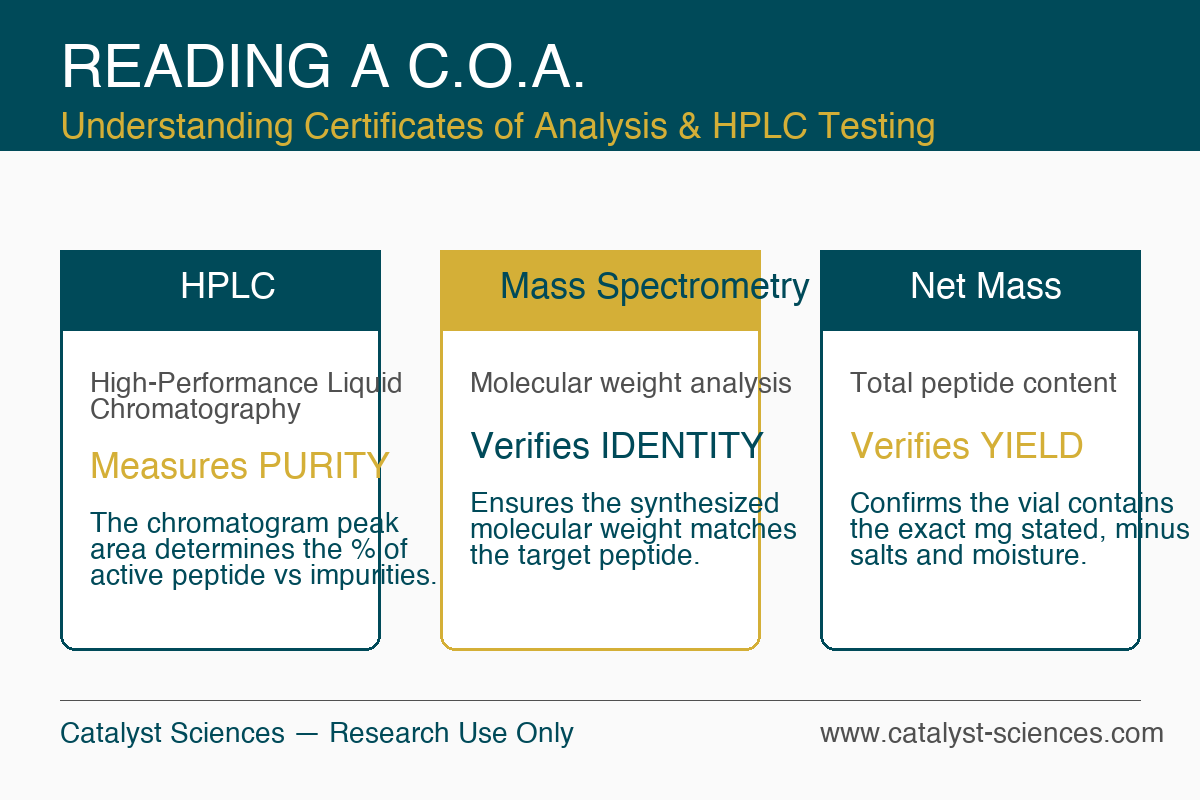
Understanding Certificates of Analysis & HPLC Testing
HPLC: High-Performance Liquid Chromatography
HPLC is the primary method used to determine the Purity of a peptide. During HPLC, the peptide sample is dissolved in a solvent and forced through a column packed with a solid adsorbent material under high pressure. Different molecules in the sample interact differently with the adsorbent, causing them to exit the column at different times (retention time).
The result is a chromatogram graph displaying various peaks. The primary, massive peak represents the target peptide. Smaller blips along the baseline represent impurities (such as truncated peptide chains that failed to fully synthesize). The purity percentage is calculated by determining the area under the primary peak relative to the total area of all peaks combined. A high-quality research peptide should demonstrate an HPLC purity of ≥99%.
MS: Mass Spectrometry
While HPLC tells you how pure a substance is, it does not tell you what the substance actually is. That is the role of Mass Spectrometry (MS). MS determines the Identity of the peptide by measuring its mass-to-charge ratio.
Every peptide sequence has a very specific theoretical molecular weight. The mass spectrometer ionizes the sample and measures the mass of the resulting molecules. The resulting graph will show a peak that must perfectly align with the theoretical molecular weight of the target peptide. If you order Retatrutide (Molecular Weight: ~4731 g/mol) and the MS shows a mass of 4113 g/mol (Tirzepatide), you know the identity is incorrect, regardless of how “pure” the HPLC claimed it was.
Net Mass Testing
The final critical component of a COA is Net Mass or Quantitative Analysis. When a vial is labeled “10mg,” this refers to the net mass of the active peptide. However, lyophilized peptides also contain trapped moisture and counter-ions (salts like TFA or Acetate) left over from the synthesis process.
If a manufacturer simply weighs 10mg of raw lyophilized powder and puts it in a vial, you are actually receiving roughly 7-8mg of active peptide and 2-3mg of salt/water. Top-tier manufacturers conduct quantitative analysis to determine the exact peptide content fraction, and then over-fill the vial (e.g., putting 13mg of total powder into the vial) to ensure the researcher receives exactly 10.0mg of the active compound.
Conclusion
A legitimate COA must contain, at minimum, an HPLC chromatogram proving purity and a Mass Spectrometry graph proving identity. Relying on compounds without verifiable, third-party analytical testing introduces unacceptable risk into any rigorous research model.
Disclaimer: This article is for informational laboratory reference only. Catalyst Sciences products are sold strictly for laboratory research use only (RUO). Not for human or veterinary use. Not a drug, food, or cosmetic. Not for diagnostic or therapeutic use.